From March 12 to 15, 2025, AUDIOWELL showcased its innovations at the AWE held at the Shanghai New International Expo Centre. During the exhibition, the company officially launched its third-generation ultrasonic material recognition module, delivering a brand�new floor material identification solution for smart cleaning devices such as robotic vacuums. This module breaks through the structural limitations of traditional ultrasonic solutions that require mounting holes larger than 3 mm, achieving a blind-spot-free design that allows flush mounting with the device housing. With an ultrasonic frequency of up to 300 kHz and precise echo detection capabilities, the module can identify more than nine types of floor materials, providing critical perception support for robotic vacuums to autonomously match cleaning modes.
Technical Principle: Acoustic Impedance Difference as the Basis for Material Recognition
Different materials exhibit significant differences in their reflection and absorption of ultrasonic waves – a physical phenomenon that forms the theoretical foundation of ultrasonic material recognition. From an acoustic perspective, when an ultrasonic wave travels from air into a floor medium, reflection and transmission occur at the interface between the two media. The intensity of the reflected energy depends on the difference in acoustic impedance (the product of medium density and sound velocity) between the two media. The greater the impedance difference, the stronger the reflection; conversely, when impedances are similar, the reflection is weak, and most of the energy is absorbed or transmitted by the material.
AUDIOWELL’s third�generation ultrasonic material recognition module leverages this physical property. By emitting ultrasonic pulses and receiving echoes reflected from the floor, it analyzes the intensity, phase, and attenuation characteristics of the echo signal in real time. The built-in algorithm compares the echo features against a preset acoustic fingerprint database of materials, thereby accurately distinguishing between wood flooring, tiles, short�pile carpet, long�pile carpet, stone, and many other materials. This solution is unaffected by environmental factors such as ambient light, color, or texture, maintaining stable and reliable recognition even in dark or complex lighting conditions.
Blind-Spot-Free Design: Breaking Traditional Installation Constraints
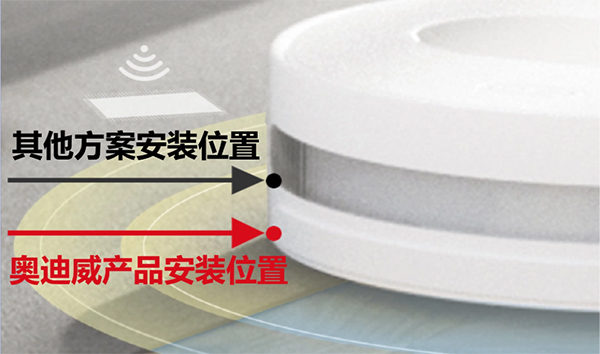
Conventional ultrasonic sensors emit sound waves outward and receive reflected echoes. However, due to a brief ringing decay period after the transducer emits a pulse – during which it cannot receive valid echoes – a near-field blind spot is formed. This physical limitation means traditional solutions typically require mounting holes larger than 3 mm on the device housing, with the sensor protruding or exposed to avoid obstruction of the sound waves by the housing and to ensure effective measurement in the near field.
AUDIOWELL’s third-generation ultrasonic material recognition module achieves a breakthrough blind-spot-free design. Through optimized transducer construction, precise matching of damping materials, and fine-tuning of the driving circuit, the module significantly shortens the ringing decay time, eliminating the near�field blind spot. As a result, the sensor can be mounted flush with the device housing without requiring protruding holes. This design offers multiple advantages: it improves the aesthetic appeal and integration of the robotic vacuum; reduces dust and hair accumulation around sensor openings, lowering maintenance frequency; and simplifies the assembly process, enhancing production efficiency and structural reliability.
High Frequency Ultrasound and Directivity: Enhanced Recognition Accuracy and Installation Flexibility
The accuracy of material recognition depends largely on the choice of ultrasonic frequency. Higher frequencies result in shorter wavelengths, offering higher spatial resolution at the interface and a stronger ability to distinguish subtle differences between materials. This module operates at an ultrasonic frequency of up to 300 kHz. Compared to conventional ultrasonic sensors operating between 40 kHz and 200 kHz, its wavelength is much smaller than the surface structure characteristics of common floor materials, enabling it to more sensitively capture differences in acoustic response and achieve fine�grained classification of over nine material types.
High frequency also brings excellent directivity. According to acoustic theory, the directivity of a transducer is positively correlated with frequency and radiating surface size – the higher the frequency and the larger the radiating surface, the more concentrated the sound beam and the smaller the side-lobe interference. The module is available in multiple sizes, including 12 mm and 16 mm probe diameters, allowing equipment manufacturers to select the optimal configuration based on chassis space, mounting position, and detection accuracy requirements. The focused sound beam enables the sensor to precisely target the floor area directly beneath the robot, avoiding surrounding interference and ensuring accurate and consistent recognition.
Empowering Robotic Vacuums: From One Mode Fits All to Precision Adaptation
Floor material is a critical variable affecting cleaning strategy. Wood flooring requires gentle suction to avoid scratches, tiles can tolerate large-volume mopping, and long-pile carpet demands high suction for deep cleaning. Traditional robotic vacuums often rely on visual recognition or manually defined zones to switch modes – the former is susceptible to lighting variations, while the latter lacks flexibility.
Robotic vacuums equipped with AUDIOWELL’s third�generation ultrasonic material recognition module can perceive the floor material ahead or directly beneath them in real time and automatically match the optimal cleaning mode. When the robot moves from a hard floor onto a carpet, the sensor completes recognition before contact, and the system promptly adjusts suction, lifts the mopping pad, or changes brush roll speed – achieving a seamless transition. This intelligent decision�making based on physical perception gives cleaning devices the true ability to “adapt to local conditions,” improving cleaning effectiveness while reducing reliance on manual intervention.
Driving Smart Cleaning Upgrades with Sensing Technology
From particle sensing to underwater ranging and now ultrasonic material recognition, AUDIOWELL demonstrated the deep application of “sense & control technology” across a variety of cleaning scenarios at AWE 2025. The newly launched third�generation ultrasonic material recognition module solves the installation constraints of traditional ultrasonic solutions with its blind�spot�free design, and balances precision and flexibility with high�frequency acoustics and multiple size options – showcasing the company’s comprehensive technical strength in acoustic sensing, structural design, and system integration.




 Focus on us